

Insights from a Futura Camp (ZuBerlin 2026) talk
thoughts on real mechanics of pop-up cities: stake over price, culture over policy
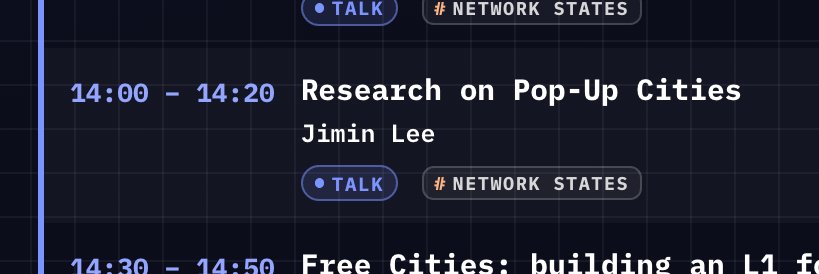
i gave a short talk @JoinFutura on sunday about @popupcities. some who missed it asked, and since it was not the kind of introductory session to our research but rather niche and chaotic (i was selfishly bored of my own repetitive intro talks and wanted to try sth new), i'm writing a bit more polished ver. of the takes + additional explanations.
> a pop-up city blends two opposite dynamics - community (you contribute into it; value flows in) and service (it delivers to you; value flows out). the blend is what feels extractive or confusing. the clean move i observed works best is to pick one, unapologetically (80:20 or more, not like 50:50). both choices aren't really free anyway - in a temporary format, community-mode depends on legibly non-extractive economics, which depends on someone subsidizing the cost (organiser self-funding, crowdfunding, donation). without that subsidy, the economics push you toward service no matter what you call it. (when i said community contribution, i don't mean the 'leave it as you found it' level)
> however, the community <> service dynamics are not inherently opposite. you might want to contribute more because you paid more, because the real driver behind this is stake, not price: how much you've invested / have at stake (time, energy, money, reputation, relationships, etc.) and how long you intend to stay. it depends on the state of the individual, not the setting (one-off / recurring / permanent), even though permanent ones would naturally hold more people prone to contribute compared to one-offs. but that only shifts the typical stake, not the rule.
> different pop-up cities look different on the surface but are the same machine underneath: gather specific/curated people → create good interaction → convert into relationships and outcomes
> the difference between them is only what each organizer converts the gathering into (jurisdiction / brand / ecosystem or product onboarding / etc. )
> the event isn't a placeholder for building a network state - the event *is* the work. nothing really dissolves when an edition ends, when it's done right; people leave with real relationships and memories that compound. however, to accelerate the compounding, we need to fill some gaps: we don't work across pop-up cities as much, and there's an inevitable (but translatable) discrepancy between the stated or implied vision vs. how it actually looks day to day - logistics, programming, dinners, tickets - which makes it feel abstract what this even is and how it's different from other formats.
> the policy layer (e-residency, visa, tax, crypto-friendly) is important but copyable, and not really the winning edge in jurisdiction competition. community and culture (the kind people form their identity from) is, and whether it truly serves your needs as a community/city, especially when you're dealing with people who seek 'much better,' not 'less bad' (though i believe this line of effort will become a real exit plan for the underprivileged or people in more difficult situations too).
> pop-up cities are built to produce that uncopyable thing, whether they currently do it well / optimise for it or not.
> how to run a better edition next time is one question. we also should ask more about what we're building across all of them.
This writing was first shared as a Twitter/X post: https://x.com/jiminleex/status/2069736039900447062
Subscribe to @popupcities newsletter
Writeups, frameworks, and whatever the research turns up. Only sent when there's something worth sending. Follow @popupcities on X for the day to day.