
Summary
A pop-up city is a temporary physical gathering that brings together people with shared interests or values to create a short-lived, city-like environment, often including shared spaces, social norms, cultural activities, services, and coordination structures. Roughly 107¹ have been catalogued as of 21 May 2026, and around 50 of those carry ambitions beyond hospitality: governance experiments, research environments, prototypes for new kinds of institutions.
The word is not new. Pop-up shops, pop-up restaurants, and pop-up urbanism² have used it for decades. What this report covers is narrower: a curated residential cohort, time-bounded, doing substantive shared work, often with explicit governance experiments. That form cohered after the 2023 founding case and has grown fast enough that no shared playbook has caught up. Operators rebuild from scratch each time. Funders evaluate without comparable categories. Host jurisdictions often absorb near-term costs while much of the value appears later, indirectly, or outside standard economic measures. This report is about closing that gap by asking three questions: what works, what breaks, and what the field needs in order to grow from a curiosity into a category that operators, funders, and host jurisdictions can evaluate, invest in, and replicate.
Jump to your role: Operators & organisers, Investors & funders, Host jurisdictions
1. What pop-up cities are
A pop-up city is not a conference, a co-living house, a retreat, an intentional community, or a special economic zone. Pop-up cities occupy a band that older institutional forms did not fully fill. They are longer than a festival or conference (which run days, not weeks), shorter than a university or a city, larger than a retreat or residency (usually tens of people), smaller than a city or country. The form is a curated cohort, usually 2 to 12 weeks long, hundreds to low thousands of people.
Exhibit 1.1
Where Pop-up Cities Fit: Mapping Human Gatherings by Duration and Scale
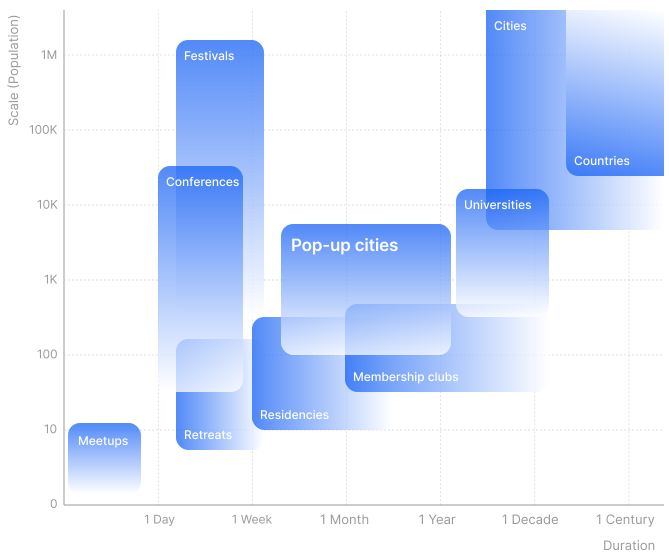
Two axes, both log-scale: how long a gathering lasts (X) and how many people it involves (Y).
© Adapted and redrawn from Janine Leger’s slide (2023), which credits Balaji Srinivasan’s graphic “A Classification of Cloud Formations, Taking Physical Shape, By Scale and Duration. Include As Yet Unobserved Formations” in The Start of Startup Cities (2021). The exhibit further draws on Eric Miki’s adaptation in Alternative Communities Guide: An Evidence-Based Taxonomy of Emerging Physical and Virtual Societies, and on Danwen Ji and Botao Amber Hu’s version in Infrastructuring Pop-Up Cities with “Social Layer”: Designing Serendipitous Co-Livings for Temporary Intentional Communities.
Pop-up cities can be defined by the following four conditions - co-presence, time-bounded intensity, selection-generated trust, and shared intention (Exhibit 1.2) - that all hold at once. Remove any one and you have something else.
Where the four conditions hold, a pop-up city becomes a compressed test bed: a place to run institutional questions live that a permanent city cannot easily experiment with. How do you select a community? How do you make and enforce rules? How does value flow between visitors and hosts? Whether the answers transfer back to permanent settings is the field's central open question.
In practice, you spend weeks in one place with a curated cohort, working on something substantive, with the clock running toward a known end date. Conversations start at depth because the filter has done its work, sustain over breakfasts and corridors because everyone is present, and accumulate weight because the cohort will disperse soon. What participants do with that compression is the question every pop-up city is trying to answer.
"Serendipitous collisions."
A residency fellow in a pop-up city
"It feels like it was 10 years packed into one month."
An artist and regular attendee of pop-up cities
Exhibit 1.2
The four conditions
Co-presence
Participants share a set of physical places daily for the full duration. They eat breakfast next to someone whose work they may already know. They repeatedly encounter familiar faces, conversations, and working contexts without arranging meetings in advance.
Time-bounded intensity
The event has a fixed start and a fixed end, often marked by opening and closing ceremonies. This temporal constraint creates urgency and momentum. Relationships form quickly, collaboration becomes easier to initiate, and the limited window gives participants a reason to turn shared attention into meaningful short-term outcomes.
Selection-generated trust
An explicit filter (application, referral, vouching, contribution history, or invitation) means participants arrive with a baseline assumption that others have passed the same bar. This does not eliminate conflict or difference, but it lowers initial social friction. People can assume a shared level of good faith and familiarity with the community’s values before deeper trust has had time to form.
Shared intention
Participants arrive to work on something substantive together, not simply to consume a programme of talks. They usually enter with some understanding of the community’s rules, values, themes, or tracks, and with a willingness to contribute through their domain of expertise or interest. They cross-pollinate across fields, self-organise sessions, host dinners, and create forms of participation that were not fully programmed in advance.
Who this report is for
The report primarily serves three audiences. Each reads the same evidence but needs different things from it.
Exhibit 2
Three audiences
Operators & organisers
Founders, core team members, programme leads, ops staff, residency coordinators: the people running pop-up cities.
"Which design decisions matter most, and how do I avoid the predictable failures?"
Investors & funders
Capital allocators, grant-makers, philanthropists, family offices, ecosystem foundations, DAOs funding the space or considering it.
"How do I evaluate these ventures, and what separates the ones that last from the ones that collapse?"
Host jurisdictions & institutions
City governments, regional authorities, cultural institutions, universities, think tanks: organisations engaging as hosts, partners, or convenors.
"Does hosting create value, and what terms help the local community?"
Section 7 below answers the questions.
The landscape
The field does not follow a single model. What stays constant across the cases studied is a shared design space, not a shared model. Four recurring types appear, sorted by how long they run and how much institutional ambition they carry.
Most pop-up cities are short. The longer, higher-ambition forms, Season and Proto-jurisdiction, are rarer and harder to sustain.
Exhibit 3
The four archetypes

15 of the 20 cases studied closely ran shorter than 8 weeks. The longer, higher-ambition forms are numerically rarer.
How pop-up cities compare
Seven intellectual positions shape how people in the field explain why pop-up cities exist and what they are for. The d/acc lineage and the network state lineage are the two most often invoked by operators in the cases studied; neither offers an exhaustive treatment of the form, and several other positions bear on the field's analytical questions. The same case can read differently depending on which position a reader brings.
Exhibit 4
The intellectual landscape
Position (Lineage)
What pop-up cities are for
Key works
d/acc
Field sites for governance and defensive-technology research.
Network state
Recruitment and cohort formation for a permanent settlement.
Srinivasan, The Network State (2022)
Libertarian / exit
Small-footprint demonstrations of alternative rule-sets.
Davidson and Rees-Mogg, The Sovereign Individual (1997); Friedman on seasteading; Free Cities Foundation
Developmentalist / charter-cities
Prototypes of rules-based zones for economic development.
Romer, charter-cities papers; Charter Cities Institute; Próspera writings
Plurality
Testbeds for plural-voting, quadratic-funding, and liquid-democracy mechanisms.
Tang and Weyl, Plurality (2024); RadicalxChange essays
Commons-governance / Coordi-nations
Temporary overlays on existing state functions; commons-infrastructure prototypes.
de Filippi, Coordi-nations; Bauwens, Network Sovereignties in the context of macrohistorical patterns; Foster and Iaione, Ostrom in the City (2017)
Prefigurative-community
Cultural and communal experiments for a bounded period.
Bey, T.A.Z. (1991); Burning Man Project, "Ten Principles" (Harvey, 2004); Chen, Enabling Creative Chaos (2009)
The full report (Chapter 4) sets out each position. Chapter 12 §12.3 carries a counter-view drawn from Buterin's December 2025 Let a Thousand Societies Bloom essay (a "worrying pattern" of pop-ups becoming shorter, smaller, and less experimental over time).
5. Six findings
Six findings stand out, drawn from the strongest agreement across independent sources. Each rests on the highest tier of evidence in the report.
Exhibit 5
The six findings
01 Valued outcomes are under-measured across the cases studied.
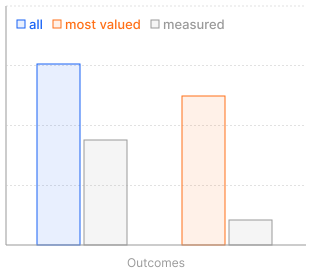
Trust, serendipitous connections, ambient collaboration, and the long arc of work begun in-event are what people value. Standard tools measure short-term proxies instead. The gap is wide and consistent, and looks built into the form rather than incidental.
02 Intrinsic motivation outlasts financial incentives, up to a point.
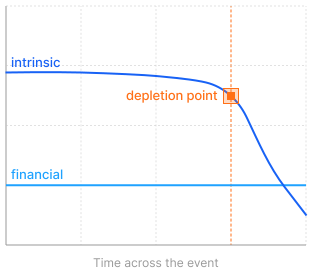
Purpose and belonging hold longer than pay, but not indefinitely. The most committed contributors hit the depletion point hardest.
03 Coordination ceiling sits somewhere in the low hundreds of participants.
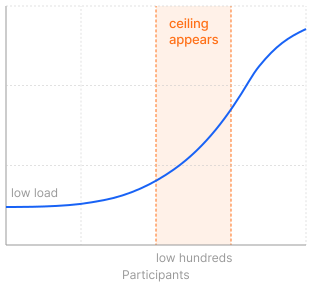
Safety, host relations, and coordination all need more capacity than teams plan for. The coordination ceiling appears to sit somewhere in the low hundreds of participants, though that figure is a working hypothesis rather than a benchmark.
04 Flagship carries a dependency layer; small permanent doesn't.
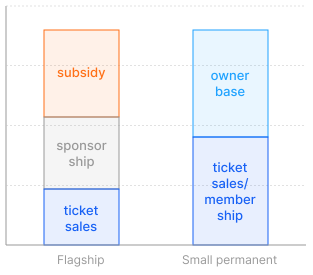
Every surviving large event relies on some combination of premium pricing, ongoing subsidy, and sponsorship. The clearest documented alternative is the small permanent-space model, and it has not been tried at large scale.
05 Innovations are generated; capture and transfer fails.
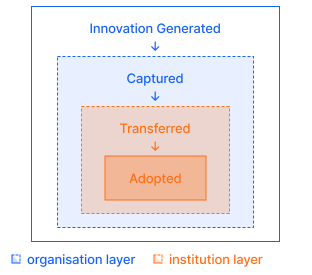
Two distinct bottlenecks, at different layers. Capture often fails inside the originating organisation: playbooks not written, retrospectives skipped. Even where capture happens, transfer is gated by the receiving institution's incentive to adopt.
06 The ecosystem has not yet reached a tipping point.
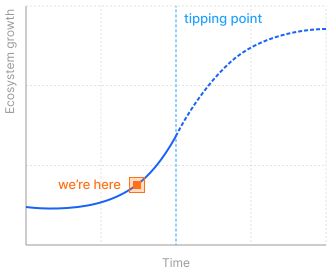
Capital density, a talent pipeline, and a legible narrative category are the conditions that would carry the field past the inflection on the evidence reviewed.
Figures are schematic and relational rather than a fixed measurement.
How pop-up cities fail
Three failure modes recur often enough to be treated as features of the model. Each works at a different level.
Exhibit 6
Three failure modes by level
Operational overwhelm.
Small founding teams cannot sustainably cover everything the format demands.
Event Level
Institutional knowledge loss.
No playbook, no retrospective, high organiser turnover. Each iteration starts over.
Organisation Level
Pre-tipping-point fragility.
Fragmented capital, dispersed talent, and a narrative mainstream institutions cannot read.
Field Level
A connecting thread runs through all three: the knowledge that would prevent the failure usually exists somewhere already. It just is not captured, shared, or built into how the next team works. That makes knowledge infrastructure the failure mode with the most accessible fixes.
What this means for you
This is the summarised, role-specific version of the report's implications. Each role below carries the headline pattern, a set of reference tables in compact form, and a pointer to the chapters in the full report where the underlying evidence and reasoning sit. The tables here are condensed; the full evidence base, case examples, and qualifying detail live in the chapters cited.
7.1 For operators & organisers
The failure patterns are knowable in advance. Chapter 13's 18 design decisions are worth walking through before the first event; several are typically decisions first-time organisers had not consciously considered. Naming an owner for each of the 7 core institutional functions (safety, host relations, financial management, conflict resolution, coordination, knowledge capture, succession) reduces the chance that a function gets handled by whoever is free during a crisis. The 6 starter metrics are a reasonable set to track from day one.
Exhibit 7
Eighteen design decisions by area
Area
Decisions
Membership and selection
1. Selection mechanism · 2. Economic accessibility · 3. Tier structure · 4. Reputation portability
Governance and legitimacy
5. Governance mode · 6. Legitimacy basis · 7. Escalation protocol
Incentives and funding
8. Funding model · 9. Subsidy level · 10. Contribution recognition
Enforcement and operations
11. Coordination mode · 12. Role clarity · 13. Staffing model · 14. Enforcement ladder
Economics
15. Archetype and geography · 16. Sustainability strategy
Host-jurisdiction interface
17. Host-relations model · 18. Jurisdictional strategy
Six decision areas; the eighteen choices each new event makes, consciously or by default. Most failures cluster around three or four of these. For the detailed evidence and reasoning, read Chapter 13 (design decisions) in the full report.
Exhibit 8
Seven minimum viable institutional functions
#
Function
1
Safety and incident response
Code of conduct exists but does not specify consequences, escalation, or who decides
2
Host-relations capacity
Host treated as logistics rather than relationship; no named local-integration owner
3
Financial management
Organiser knows total budget but not weekly burn rate
4
Conflict resolution
No structured process between informal signalling and formal removal
5
Coordination infrastructure
Coordination overhead climbing as a share of total team hours
6
Knowledge capture
Post-event debrief not scheduled before the event begins
7
Succession planning
All-volunteer or underpaid-core staffing with no documented procedures
Functions every pop-up city needs an owner for. The leading indicator is what visible-from-outside sign appears when the function has no owner. For the detailed evidence and reasoning, read Chapter 14 (functions) in the full report.
Exhibit 9
Six 'Tier 0' metrics to track from day one
#
Metric
1
Attendance and departure rate
Early departures signal community-fit failure or safety concerns
2
Programming engagement rate
Sustained decline is an early signal of dissatisfaction
3
Organiser hours per week
Sustained round-the-clock workload is the burnout warning sign
4
Return intention (1 to 10)
Markedly lower than the typical 7.5 to 9.5 range is a warning sign
5
Budget burn against plan
Variance widening in early weeks signals planning failure or scope creep
6
Formal incident count
Upward trend signals enforcement-ladder failure or selection-mechanism breakdown
The minimum measurement set a small team can feasibly track. Each surfaces a different failure mode early. For the detailed evidence and reasoning, read Chapter 14 (metrics) in the full report.
7.2 For investors & funders
Three leverage points stand out in the cases studied. Pre-committed capital pools, talent-retention infrastructure that lets experienced organisers professionalise rather than burn out, and legible narrative artefacts that bring the field into mainstream institutional view. On any individual venture, flagship-scale events tend to remain dependent on continued funding; funding a pop-up city as if it will reach self-sustainability without a clear transition mechanism reads more like ongoing patronage than investment. That can still be worthwhile, but it is worth naming accurately. The absence of basic tracking metrics in an operator's pitch is itself a diligence signal.
Exhibit 10
Five funding models and their fragilities
Funding model
Zero-ticket / full sponsorship
Consumer-mode participation; low commitment signal
Sponsorship-dominant
Informal sponsor influence; editorial chilling effect; funding volatility
VC / startup-funded
Risk-appetite mismatch; community members bear downside they did not consent to
Self-funded (zero external subsidy)
Revenue cap limits scale; owner bears disproportionate risk
Grant plus scholarship
Donor fatigue; "college experience" return-on-investment mismatch
Each model carries a distinct failure shape. Several flagship-scale cases combine two or more. For the detailed evidence and reasoning, read Chapter 10 (economics) and Chapter 12 (failure mode) in the full report.
7.3 For host jurisdictions & institutions
The direct economic impact of hosting a pop-up city may be modest. The lasting value is institutional rather than economic: new organisations, new policy ideas, a place in a global knowledge network. That value is real, but it shows up over years, not over one event, and it depends on genuine local integration rather than token inclusion. Local integration in practice rests on three components that have to hold together: intention (a real commitment to integrate, not performative inclusion), resources (budget and people allocated to the work), and facilitation (structural mechanisms such as translation, coordination, and community liaison). Partial implementation produces transactional rather than co-productive relations.
Exhibit 11
Host engagement spectrum
Model
Regulatory mismatch; electoral-cycle continuity gaps; friction over local value flow
Less regulatory mismatch but local community remains outside the form's main loop
Operational complexity; depends on partner stability and shared incentives
Multi-year investment required; needs partner continuity across electoral cycles
Four observed engagement models. Each carries a different friction profile at the local-community and jurisdictional layers. For the detailed evidence and reasoning, read Chapter 10 §10.4 (host interface), Chapter 13 §13.6 (host-jurisdiction design decisions), and Chapter 9 (operations) in the full report.
Hosting can range from logistics-only (visas, venue, permits) to government-sanctioned co-design. Logistics-only is workable but raises chances of regulatory mismatch, continuity gaps on 2 to 4 year electoral cycles, and friction over how value flows to local constituents. Lower hosting barriers, investment in local-integration infrastructure, and multi-year evaluation horizons are the practical implications.
This summary makes evidence-weighted claims, not population-wide statistical ones. Where it says "the field", it means the documented pop-up city ecosystem the research could see, and prevalence language should be read as directional unless a specific count is given.
Emerging sustainability models at scale (community-anchor subscription, endowment, real estate) have no operational track record at the scales they describe. The legal and regulatory landscape varies by jurisdiction and falls outside the scope. On-chain governance mechanisms appear primarily as failure modes when scoped to broad collective decision-making; narrowly scoped tools (credentialing, access control) appear functional. Economic data is directional rather than precise. The report does not cover festival cities, mass religious gatherings, refugee and disaster settlements, commercial brand activations, or the environmental sustainability of build and teardown.
This web summary is designed to stand alone as a complete read for most audiences. Chapter references throughout point to the full report for readers who want the detailed evidence and reasoning behind each claim. The full report, with all chapters, exhibits, and the methodology, is available alongside this summary. It rests on 93 coded interviews, 86 valid survey responses, and 299 coded desk-research sources, gathered between November 2025 and April 2026.
Footnotes
1 This case database lists the 107 pop-up cities. It is the working frame for the pattern claims in Chapter 3 (landscape), Chapter 5 (findings), and the distributional references throughout the report. A case is included when (a) it self-identifies as a pop-up city or functionally equivalent term, and (b) at least two sources corroborate the event: a website, a directory listing, a social media or blog post, an event-platform page, direct exchange with an organiser or participant, or first-hand fieldwork. The database is compiled through desk research, organiser and participant outreach, and fieldwork, in collaboration with xyz.city and with partial use of their public API. All 107 cases are listed in the accompanying directory.
2 On the lineage of the term: Wikipedia's Pop-up retail covers pop-up shops, stores, and restaurants; Tactical urbanism covers pop-up urbanism.
© 2026 Pop-up City Research Initiative and Thou Ārt Research.
Unless stated otherwise, text and exhibits are licensed under CC BY 4.0 and may be shared or adapted with attribution. Research materials not published in the report, including interviews, coded excerpts, identifier registry, and consent-gated case profiles, remain reserved. Names and marks remain the property of their respective owners.
Be the first to receive new publications and updates from Thou Ārt Research and the Pop-up City Research Initiative. Alternatively, follow us on X for the fastest updates.
By entering your email address and clicking “Subscribe”, you agree to receive newsletters, project updates, and related communications. You can unsubscribe at any time. For more information on how we process your personal data and your rights, please review our Privacy Policy.