

July 30, 2026 ∙ 9 min read
Summary
A pop-up city is a temporary physical gathering that brings together people with shared interests or values to create a short-lived, city-like environment, often including shared spaces, social norms, cultural activities, services, and coordination structures. 107 have been catalogued as of May 21, 2026,1 and around 50 self-describe ambitions beyond hospitality: governance experiments, research environments, prototypes for new kinds of institutions.
The word itself is older than the form.2 What this report covers is narrower than its retail ancestors: a curated residential cohort, time-bounded, doing substantive shared work, often with explicit governance experiments attached. That form cohered after the 2023 founding case and has grown faster than its supporting infrastructure. Operators rebuild from scratch each time, funders evaluate each venture from first principles, and host jurisdictions often absorb near-term costs while much of the value appears later, indirectly, or outside standard economic measures. The report asks three questions of the evidence: what works, what breaks, and what the field needs in order to grow from a curiosity into a category that operators, funders, and host jurisdictions can evaluate, invest in, and replicate.
Jump to your role: Operators & organisers, Investors & funders, Host jurisdictions
1. What pop-up cities are
A pop-up city occupies a band that older institutional forms did not fully fill: longer than a festival or conference, shorter than a university or a city, larger than a retreat, smaller than a town. The typical case is a curated cohort of hundreds to low thousands of people, together in one place for 2 to 12 weeks.
Exhibit 1 – Where Pop-up Cities Fit: Mapping Human Gatherings by Duration and Scale
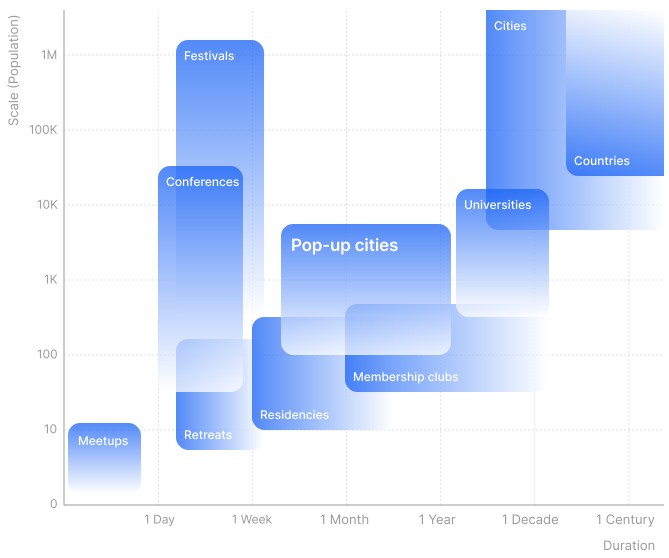
Two axes, both log-scale: how long a gathering lasts (X) and how many people it involves (Y).
© Adapted and redrawn from Janine Leger's slide (2023), which credits Balaji Srinivasan's graphic "A Classification of Cloud Formations, Taking Physical Shape, By Scale and Duration. Include As Yet Unobserved Formations" in The Start of Startup Cities (2021). The exhibit further draws on Eric Miki's adaptation in Alternative Communities Guide: An Evidence-Based Taxonomy of Emerging Physical and Virtual Societies, and on Danwen Ji and Botao Amber Hu's version in Infrastructuring Pop-Up Cities with "Social Layer": Designing Serendipitous Co-Livings for Temporary Intentional Communities.
Duration and scale locate the form; they do not define it. The working definition rests on four conditions that all hold at once: daily co-presence, a fixed start and a fixed end, selection-generated trust from an explicit entry filter, and a shared intention to work on something substantive together. Remove any one and you have something else, a conference, a co-living operation, a retreat, a community that aims at permanence. Charter cities and special economic zones fail differently: they seek changes to the legal substrate itself, where a pop-up city operates as a guest within the host's existing rules, a boundary Section 4 returns to. The full condition-by-condition test is on the Frameworks & tools page.
Where the four conditions hold together, the gathering becomes a compressed test bed: membership rules, governance mechanisms, economic design, and host relations, questions a permanent city can only vary over decades, get set up, run, and wound down inside one observation window of weeks. Whether the answers transfer back to permanent settings is the field's central open question, and nobody has yet demonstrated it either way.
2. Who this report is for
Three audiences read the same evidence and need different things from it. Operators and organisers ask which design decisions matter most and how the predictable failures are avoided. Investors and funders ask how these ventures are evaluated and what separates the ones that last. Host jurisdictions and institutions ask whether hosting creates value, and on what terms. Section 7 carries the role-specific implications.
3. The landscape
The field does not follow a single model; what stays constant across the cases studied is a shared design space. Setting aside the largest benchmark comparator, catalogued cases run from roughly 30 to 5,000 participants, most over 2 to 12 weeks. Two dimensions organise the cases better than geography, theme, or funding source: duration and institutional ambition, which together track governance complexity, cost structure, membership architecture, and the likeliest failure mode.
Exhibit 2 – The four archetypes
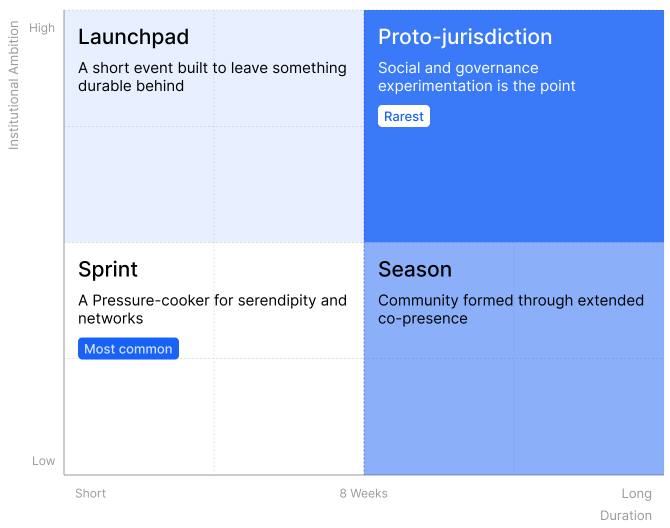
15 of the 20 cases studied closely ran shorter than 8 weeks. The longer, higher-ambition forms are numerically rarer.
The four types (Sprint, Launchpad, Season, Proto-jurisdiction) behave as stages as much as categories: the common path starts short and low-ambition and drifts toward longer duration and higher ambition as capacity accumulates, and cases that invert the path appear failure-prone. Durability, where it exists, lives at parent level: 2 parent entities report 5+ years of operation without external-grant or per-event-sponsorship dependence, and both anchor short events to a small permanent venue (Ch.3).
4. How pop-up cities compare
Seven intellectual positions shape how people in the field explain what pop-up cities are for, from the gathering as the point (the prefigurative-community lineage) to a rehearsal for permanent arrangements (the network-state lineage); the full table of positions and key works sits on the Frameworks & tools page. Checked against operations, the network-state doctrine decomposes informatively: its geographic sequence (start online, acquire territory later) reversed on contact with operations, while its founder-authority governance prescription had nothing to reverse (Ch.4).
The comparison also carries the most practical result in the report for hosts: structure, not vocabulary, predicts host-jurisdiction risk. Nearly every documented host rejection or clawback in the evidence sits in adjacent forms carrying design-time markers (land tenure beyond an ordinary lease, legal derogation, displacement of residents' rights) that pop-up cities as studied here mostly lack; one pop-up city proper now has a documented rejection, a reported shutdown order (case A.2 in the full report). One hedge belongs alongside: no host official has been interviewed anywhere in the evidence base, so a host that quietly declined a permit would be invisible to it.
5. Seven findings
The research tested 22 numbered hypotheses; the register carries 24 entries (two hypotheses split into halves that earned separate verdicts): 11 supported, 11 qualified, 1 contested, 1 under assessment. The seven findings below are drawn from that register, each with the report's confidence grade.
01 Legitimacy rests on a record no one keeps. · High confidence
Participants consistently value trust formation, ambient collaboration, serendipity, and the long arc of work begun in-event; operators track attendance and budgets. The field claims legitimacy on competence and track record, yet the track record goes unrecorded, so no participant, funder, or host can audit it. Funder fatigue in the cases studied traces to the same gap.
02 Patron capital underwrites the form as practised. · High confidence
Most models consume more than they generate, and mission-aligned patron capital typically closes the difference; in the mid-scale cases studied the backer is often a single committed funder. Where patron money arrives without structure it also concentrates governance and leaves continuity resting on individual funders' decisions, so the operative levers are funding structure, obligations, and allocation, not volume; structured models are already appearing.
03 Founder-led operation is the default; the experiments are bounded. · High confidence
Founder authority persists at every observed scale and duration. The mechanism is liability: decisions with real stakes migrate to whoever can be held responsible, participatory elements survive where nothing expensive depends on them, and every documented transition runs toward centralised operation, none the other way. The cleanest resolution the evidence supports is to pick the governance mode on purpose and disclose it.
04 The trust machine and the host problem are the same machine. · Medium confidence
The filters that produce selection-based trust inside the gathering (application curation, price, visa and geography, referral networks) are exactly the machinery the surrounding community fails. In the cases studied, exclusion is the selection model's default output, and the counter-cases all redesigned the operating model itself. The grade is held at Medium deliberately; the accounts converge but the base is narrow.
05 Knowledge travels with people; tools get orphaned. · High confidence
Institutional innovations transfer where personnel move and a receiving structure exists on the adopting side. No artifact studied has a documented cross-community adoption record, which places the bottleneck in maintenance incentives, not idea scarcity: the ecosystem funds artifact construction and does not fund artifact maintenance.
06 The capacity floor is high, the ceiling is real, and both are priced at current technology. · High confidence
Minimum viable institutional capacity, especially for safety and host relations, exceeds most founding teams' plans. Coordination costs rise superlinearly under participatory governance, and the ceiling for participatory models appears to sit somewhere in the low hundreds of participants, a working hypothesis anchored by a single comparison. Whether AI tooling moves either figure is an open question.
07 The ecosystem is pre-tipping-point, partly by its own selectivity. · Medium confidence
The ecosystem lacks the capital density, talent density, and narrative category that a self-reinforcing adoption curve requires, plus a demand-side ceiling in a participant base that is demographically narrow. The network-state framing itself operates as a selection filter over incoming resources: it attracts mission-aligned crypto capital and tool-builders, and it repels the institutional investors and professional operators whose resources compound.
The dependencies run through the system: unrecorded outcomes (Finding 1) are part of why capital never compounds (Finding 7); patron funding (Finding 2) settles the allocation questions that keep operation founder-led (Finding 3); orphaned tools (Finding 5) are why the record in Finding 1 never gets kept.
6. How pop-up cities fail
Three failure modes recur often enough, and are heavily enough evidenced, to be treated as properties of the format. Each is knowable in advance: the leading indicators are recognisable ahead of the crisis, though the evidence does not support any specific lead time.
Exhibit 3 – Three failure modes by level
| Failure mode | Level |
|---|---|
| Operational overwhelm. Small founding teams cannot sustainably cover everything the format demands. | Event Level |
| Institutional knowledge loss. No playbook, no retrospective, high organiser turnover. Each iteration starts over. | Organisation Level |
| Pre-tipping-point fragility. Fragmented capital, dispersed talent, and a narrative mainstream institutions cannot read. | Field Level |
A connecting thread runs through all three: the knowledge that would prevent the failure usually exists somewhere in the ecosystem already. It is simply not captured, maintained, or handed over, which is Finding 5 operating at three scales at once. That makes knowledge infrastructure the failure mode with the most accessible fixes: run the retrospective, write the playbook, brief a successor.
7. What this means for you
Each role's working instruments (the design-decision checklist, the institutional-function checklist, the starter metrics, the funding and host-engagement tables) live on the companion page, Frameworks & tools. The headline patterns:
For operators & organisers. The failure patterns are knowable in advance: walk the 18 design decisions with the core team before the first event, name an owner for each of the 7 institutional functions, and track the 6 starter metrics from day one. The same record quietly does double duty, because it is the track record Finding 1 says the field claims legitimacy on and does not keep; record-keeping, before any governance reform, is the cheapest legitimacy intervention available. (Ch.13, Ch.14)
For investors & funders. Three leverage points stand out: pre-committed capital pools, talent-retention infrastructure that lets experienced organisers professionalise instead of burning out, and narrative artefacts clear enough for mainstream institutions to evaluate. No flagship or large-format case studied is financially self-sustaining absent some external cushion, so funding one without a clear transition mechanism reads more like ongoing patronage than investment; that can still be worthwhile, and it is worth naming accurately. Whether an operator tracks the starter metrics is itself diligence information. (Ch.10, Ch.12)
For host jurisdictions & institutions. Direct economic impact may be modest; the lasting value is institutional (new organisations, new policy frameworks, positions in global knowledge networks), it arrives over years, and it arrives at all only with genuine local integration, which in the cases studied has always been designed into the operating model, never appended to it. The practical implications: lower hosting barriers, investment in local-integration infrastructure, and multi-year evaluation horizons. (Ch.9, Ch.10, Ch.13)
How to read this summary, and what sits behind it
This summary makes evidence-weighted claims, not population-wide statistical ones. Where it says "the field", it means the documented pop-up city ecosystem the research could see, and prevalence language should be read as directional unless a specific count is given. Confidence grades follow the report's scheme: High rests on 3+ independent sources from 2+ source streams, Medium on 2 sources or proxy measurement. Economic data is directional rather than precise, the survey base (86 valid responses against a 200 to 300 target) is a disclosed shortfall, and the evidence does not yet carry the host community's own voice at evidential strength.
The full report, with all chapters, exhibits, and the methodology, is available alongside this summary. It rests on 92 coded interviews across 54 communities and organisations, 86 valid survey responses, and 337 coded desk-research sources, gathered from November 2025 and coded through July 2026. Of the 107 catalogued cases, 20 were studied closely: 12 consented focal cases and 8 comparators.
Footnotes
-
102 of the 107 meet the report's working definition; 5 are boundary cases carried as scale or edge benchmarks. Inclusion records self-identification, not endorsement, and requires at least two corroborating sources. The database is compiled through desk research, organiser and participant outreach, and fieldwork, in collaboration with xyz.city and with partial use of their public API. All 107 cases are listed in the accompanying directory. ↩
-
On the lineage of the term: Wikipedia's Pop-up retail covers pop-up shops, stores, and restaurants; Tactical urbanism covers pop-up urbanism. ↩
© 2026 Pop-up City Research Initiative and Thou Ārt Research.
Unless stated otherwise, text and exhibits are licensed under CC BY 4.0 and may be shared or adapted with attribution. Research materials not published in the report, including interviews, coded excerpts, identifier registry, and consent-gated case profiles, remain reserved. Names and marks remain the property of their respective owners.